Showing posts with label chemistry. Show all posts

6 February 2014

Sad Fury / Furiously Sad

By Roger Colins

Instead of dealing with our problems, Freud gave us all the easy way out with this lethal invention. 

Thinking that one has depression, makes one depressed. It's a paradox. It doesn't even exist and yet our clever little brains can force it into reality.

Try sadness or anger. It has to be one or the other and both are useful where depression is not. Being sad lets us educate our emotions, teaches us what to avoid in the future and how to deal with it when it does happen again. Anger will do the same but can also be used as motivation.

Sadness means that when we're done, we'll return to being content along with some added perspective. A little faith in the knowledge that the feeling won't last forever but will come back, and when it does, a little less intense next time. The same goes for happiness.

We want to avoid unhappiness and anger, that's what the purpose for them are. To identify the emotion, recognise it and discover where it came from so that in the future, such things may be preventable.

The only certainty we live with is death and we will always be sad when things come to an end but even then, the end is important in all things. When sadness ends, happiness begins and vice versa.

Emotions teach us to not waste our time. The trick would be to stay content.


Grumpy Teenagers

Puberty drips mind bending hormones into our blood to fire up an all enveloping furnace that burns the heart right out of us, replacing it with that annoying, infuriating sex drive.

If there were such a thing as a heart monitor for our emotional state then it would show a steady sinus rhythm up until puberty, and then go nuts. Every day after that, is a fight. A headlong, never ending war to get that insane pitch and trough back to a normal sinus rhythm.

The faster these ups and downs can be moderated, the less likely one is going to feel the illusion of depression.

Ecstatic joy is certainly a wonderful thing and where we would all want to stay, twenty four hours a day. It's not ideal however, as being mortifyingly sad every day is exactly the same thing.

What we're really after is serenity, a neutral balance between the two.

We know that happy times will come and go, we know sad times will come and go but until then, we need to be cool, calm and relaxed to see past the cloudy confusion of our emotions and work out what it was that made us so happy, what it was that made us so sad.


Neuro Chemicals

Shrinks play a dangerous game with patients because a patient will look up to their counsellor for help, even if that professional has the honesty to admit they really don't have a clue.

The patient still wants to believe this person must have some kind of understanding of the condition. They've been studying the damn subject for years. They must have some sort of answer.

Drugs, all drugs, do the exact same thing. Change the emotional state you're in. Anti depressants are specifically designed to simply remove all awareness of emotion. This is dangerous because they also remove progress. Drugs are a stop gap, the symptoms are temporarily removed but the problem carries on and gets worse the more it's left unaddressed.


Good can feel bad, Bad can feel good. Confusing, but quite fine because all that is happening is our emotions trying to figure out what we like and what we don't.

If a person managed to maintain a perfectly objective point of view upon experiencing their first kiss, or their first war time fire fight, they would not learn which they liked or not.

That person would find that they like everything and fear nothing. While the entire universe may turn into an ancient Greek interpretation of beauty, that person may be considered psychopathic and slightly less human, for these emotions are meant to make us what we are.

Therefore, a 'healthy' human would again balance them-self halfway between psychopathy and mania.


Hypnotised

Depression doesn't strictly exist because it cannot be defined. It's just a trick the mind plays to get around the problem because we can't see the forest for the trees.

Figuring out why we are depressed is insane, and that's the point. It simply doesn't exist because there is no such thing.

What we're displaying are the symptoms of utter confusion, not depression because we are so certain that it exists, so certain we feel like utter useless shit and want to know why, so it can be solved.

While logical, this happens only because objective reasoning has been replaced with an easy tag line that looks so damn accurate, but if you were to try and objectively reason what depression is you would only come up with a list of symptoms and nothing else.

Being depressed is nothing more than dancing around a problem one is afraid to face and the problem we need to face, simply doesn't exist; The problem of not knowing. Once we can admit that we don't know and may never know, then we can get back to the things that we do know and can work with.


People who are depressed are to be highly praised. These people look at life with an ideology that is pure and honest. These people view life in it's truest glory and understand that there is a solution to all problems so long as we work at them, for they have gone so far as to seek out a problem that doesn't even exist.

This is an innate, natural human condition that we all have to go through one way or another. It is the resolution of depression that is the trick, for depression is real and it's solution, illusory yet the illusory solution is based in logic and reality. Paradox solved.


Training

If everyone insists that something is real then you'll have a hard time believing anything contrary.

Control by training. It works best while still young. The brain stays quite plastic (changeable) up until the mid twenties so you've got a good ten years to teach yourself how to process the new slant to pubescent emotions.

If you're still depressed in your thirties, it's not too late but it is more difficult and this training has to employ slightly more advanced practices to compensate for a greater knowledge base but the method remains the same.

Training takes will power with concrete knowlegde and that is what we are having to learn. Instead of feeding off an emotion when it arrives, you take moment, breath once or twice and observe that emotion from a semi removed aspect.

Feel it, instead of allowing it to overwhelm and control.

Teaching oneself to control the effects of that emotion is the point so that there is give and take between the conscious part of you that conducts all deliberate action, and the randomly wired brain that fires off neurons which ever way it feels like, whenever it feels like doing it.

One can of course go too far and start feeling nothing at all. This is the same as feeling everything all the time so training has to also account for when, how much is too much sadness, or too much joy, or too much neutrality.


Anger versus Sadness

Depression accounts for these two emotions. They are in opposition. Anger is passionate, strong, a growling intensity that wants to do something positive, something actionable and fight out against that which we deem wrong.

Sadness is the opposite. Apathy, weakness, pointlessness and passive suffering. When these two opposites get mixed up then we become totally confused and label it depression.

It is worthwhile working backwards and do every effort to split depression back into these two constituents.

Deciding which bit is making us sad and which bit is making us angry gives something to work with and we'll be able to work through each in turn.

One might be depressed about work, a reason being that there is no satisfaction. We're angry that we are forced to endure this pointless job and that makes us sad. We are sad because we are unable to do anything about it, and that makes us angry.

Whichever emotion came first is the one to focus on and work through, without allowing it to delineate to the second. Stick with anger or stick with sadness because on their own there is resolve.

If sad, go talk to a loved one, cry your heart and let them feel that sadness. If angry, take a pillow and beat the shit out of it, scream, jump or run for as long and hard as you can.

Just make sure you don't let one emotion become the other until you've sorted out the first one first.

#psychology #emotions #depression

28 January 2014

Smoke

By Roger Colins

______________________________________________________________


We make it, we breathe it, see it and smell it but there's more to smoke than meets the eye. One constituent of smoke is what set off some of our greatest thinkers in history.

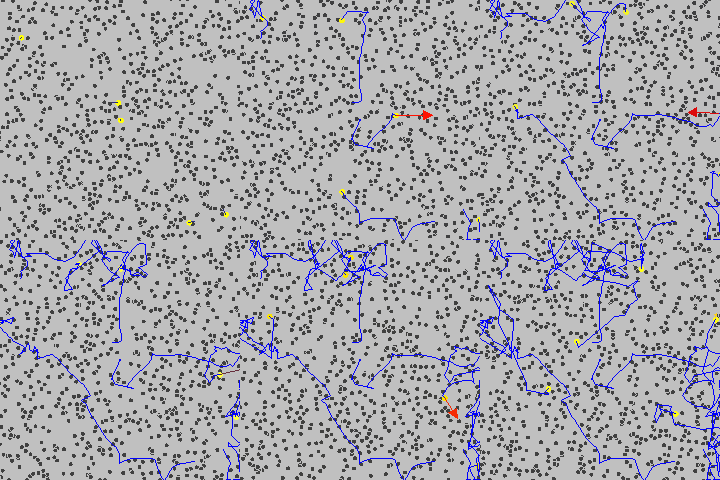
The coolest thing I ever knew about smoke was something called Brownian motion named after, Robert Brown. Principal discoverer of how a fluid particle flies about with completely random velocity and vector. Einstein backed this up in a paper on a different subject and Jean Perrin followed up on that with one of his own. Both won Nobel prizes for these works.

Any one particle displays this random behaviour, simply due to bumping into other surrounding particles when liquid or gas. The different directions and forces of all the crazy snicker snickering results in any one particle showing of, near as dammit, proper randomness. Smoke is a great example.

5 particles (in yellow) display Brownian motion


Anything that isn't solid will do the trick but we can probably see it more clearly in a cloud of smoke.

You will of course need an electron microscope to actually, kind of see it but for just being able to recognise what's going on, smoke definitely works well.

Smoke is made up of all the constituent elements that took part in the original combustion.

Combustion usually needs oxygen to bond with so you'll get a lot of oxides.

The ash you see are mostly metal oxides but of course it depends what you're burning and how hot you're burning it.

One tree might leave quite a bit of calcium carbonate in it's ash while another may be nearly all calcium oxide and if you want just carbon, you heat your wood without oxygen.

Smoke or Shoot

For all the smokers out there, you'll know that the lit cigarette gives off plumes of blue smoke and after respiring, it turns white.

Anything small enough to be soaked up by the blood cells get into the body along with everything small enough to get out, carbon dioxide for example. Depending on your tipple, there's probably only one active element that we're looking for in a puff.

Smoking must have been one of our all time favourite pastimes since we discovered fire and we must have tried everything before we found the really good stuff. Nowadays all the fun has been sucked out of it thanks to needles.

Suffice to say one gets exactly the same effect whether smoking it, shooting up or chowing down. They're just all different ways to get the thing in the blood.


Injection only works with powder. So why smoke over shoot?
We're all well aware tobacco being the most commonly smoked product in history.

The second is probably opium. Only quite recently was it decided opiates should be banned and though common in Victorian London, the product was not as readily available nor entirely socially accepted.

It has of course thrived for centuries in the Far East and spread worldwide in the form of pipes, drips, pills, powders of morphine, herion, codine, oxycodone all with their own alkaloid, strength and delivery method from the poppy.

After that, things get fuzzy. You can of course smoke anything that burns, and everything burns, if you add enough heat but here is another chemical we have enjoyed from the benefit of chemists and dealers alike.

Methamphetamine is highly popular today, more so than any other active property in recent memory. It is also most commonly smoked to achieve the most satisfactory results however, here we come upon an anomaly.

Heroin is traditionally injected whereas it's opium counterpart, usually smoked.

Looking at it one way, Heroin or diamorphine is a purer concoction from opium and morphine a purer concoction from heroin so why is one smoked while the others injected? Opium is not refined enough to inject but the others are. So what about methamphetamine?

It's the hit. As previously mentioned, the effects of any drug are the same but the net strength depends on purity, delivery and resistance.

Addicts are well known to overdose on herion more than any other drug, simply thanks to a lack of resistance over time and the choice method of delivery being one big shot.

While less common, it is just as easy to inject methamphetamine as it is heroin. Choosing to shoot up over smoking seems a balance of probability because one chemical is that much more immediate where the other is the same. Given the choice, you'd probably prefer to smoke something instead of dig around for a vein.

The King of Smoke

Marijuana can be argued as more popular than the rest of our smoking products as well as the most medicinally beneficial.

Tobacco just happens to be legal but the active tetra hydro cannabinol in marijuana would probably outsell nicotine ten to one should laws switch tomorrow.

Colorado has legalised bits of it, Holland has been smoking it, and everything else for a while now and of course the Caribbean wouldn't be the same without the stuff.

Coming in all different shapes and sizes from the home grown plant to new hybrids, we can safely say that out of all the outlawed chemicals we chose to smoke, weed wins.

The most popular smoke of all
Somewhere, someone published a paper on the psychedelic effects of marajuana but I'm having trouble finding their work.

Never the less, I can briefly recite that a study of Scandinavian origin claimed that prolonged abuse resulted in mental illnesses including but not exclusive to, schizophrenia.

I can agree that if you feed the wrong person enough of any chemical he will surly lose his mind but can base no experience of my own or those I have known that could tally with such a finding except, that all the schizophrenics I have met, all smoked weed.

Benefits?

I also lost an alternative article on the rates of lung cancer in non smokers from about six years ago. The article claiming, that roughly half of all those undergoing lung cancer treatment in the UK were non smokers.

Not to say there are no cancer causing properties in cigarettes, I just wouldn't mind a second look at the article.

Bearing in mind the different potencies of different tobaccos, there are on average 69 severely toxic chemicals known to cause cancer.

These are of course, trace elements out of a list of over four thousand, none of which are particularly friendly but that does not necessarily mean they can't be useful.

When we're in the hospital dying of cancer and addicted to morphine, all is well so long as we remember it's addictive. Tobacco is an anti inflammatory and good for irritable bowel syndrome, lowers the chances of getting Alzheimer's, Parkinson's and all kinds of allergies. Medicinal benefits exist in nearly everything, just as the risk of death does also.

Smoke currently has a nasty stigma around it. In the UK we've just passed law banning new electronic cigarettes to under 18's and decided not to ban the adverts, in the hope to convert more adults to non smokers than teenagers to smokers, so far as I understand the theory.

Either way, it's polluting the environment, annoying people with touchy noses and so on. It was not that long ago when smoking was taboo if one chose not to light up, that we had dedicated rooms to do it in and if I am right, smokers have always been very considerate.

There will be the occasional fat cat that likes to annoy an entire restaurant with his Cohiba but on the whole, there wasn't much of a fuss when asked to smoke outside, even though it seemed quite a cruel thing to do. Perhaps there isn't much space left and the olden days are far behind us. Our future is very much ahead of us however and smoking will be with us for many years to come so maybe, one day, we can have our smoking rooms back.


smoke
smoking
chemistry

18 January 2014

Building Blocks

By Roger Colins

Building blocks
A short essay on what glass is made of, and what that stuff is made of. 

Most of us are aware that sand has something to do with glass, that silica has something to do with sand and that somewhere in between silica has something to do with glass. Let's begin with Gorilla glass as it is fairly new as far as glass goes and you might have a bit of it in your hand. The first, main components of Gorilla glass are;
_________________________________________________________________
Alkali-aluminosilicate minerals.

- Alkali metals are a small number of chemical elements;

barium (Ba), beryllium (Be), calcium (Ca), magnesium (Mg), radium (Ra) and strontium (Sr). Using these metals to swap ions on the surface of glass toughens it, making it more difficult to scratch.

Plain, transparent glass

- Aluminosilicate (Al2SiO5) is a mineral composed of;

aluminium (Al), silicon dioxide (SiO2) and oxygen (O2). The three are fused together with heat to make, glass. The glass is then put in contact with monovalent ions, heat is again applied in order to swap them for the smaller alkali metal ions in the glass.

Chemical Elements
Atomic structure of Glass

The periodic table is a collection of pure chemical elements. Aluminium is a pure chemical element. Bonding two or more pure chemical elements together produces a compound chemical element such as silicon dioxide; Silicon and Oxygen.

Monovalent Ions

- Monovalent. Valence is another word for the bonds you see between atoms that hold them together and mono, means one.

- Ions. Simply any atom that have a net positive or negative charge because the electrons and protons of the atom are not evenly balanced.

Atoms
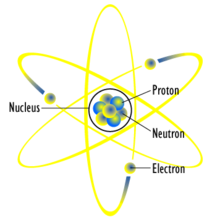
Constituent parts of an atom

All the pure chemical elements are representative of a single atom, each with it's own unique atomic number. The atomic number represents the number of protons in it's nucleus (the electrons too, as they have to be the same in number as the protons). If you have two or more atoms conjoined to each other with our valent bonds you have, a molecule. 

An atom is comprised of electrons surrounding a nucleus which is in turn comprised of protons and neutrons (except Hydrogen-1 which has no neutron);

- Electron. An elementary, negatively charged subatomic particle that has about 0.05% the mass of a proton. An electron is a fermion, a grouping for subatomic particles which means it has a specific spin.

- Proton. A composite, positively charged subatomic particle made of three quarks. Two up quarks and two down quarks. Protons are also fermions.

- Neutron. Also a composite particle made of one up quark and two down quarks. Neutrons are neither positive nor negatively charged and have a mass slightly bigger than a proton. Neutrons fall under the hadron group, the same as protons.

Quarks
One Proton = Three Quarks

Another elementary particle, they get together to form hadrons which are composite particles such as neutrons and protons. Quarks are never found on their own, they only ever exist together to form hadrons. There are six types of quarks known lovingly as flavours;

-Up. An elementary fermion with the lowest mass of all quarks. Up quarks experience all four fundamental interactions; Gravitation, electromagnetism, weak and strong interactions.

-Down. Almost exactly the same as an Up Quark but with a slightly larger mass.

-Strange (or S Quark). Heavier still than a down quark.

-Charm (or C Quark). Heavier than a strange quark.

-Bottom. A Bottom quark is a lot heavier than a charm quark, weighing in at nearly four times the mass of of a proton.

-Top. A top quark is appropriately named as it is not only the heaviest quark but the heaviest of all elementary particles. Due to it's enormous mass, top quarks are much used in particle experiments.

Fermions and Bosons

Fermions include electrons, protons and quarks, all have a half integer spin. Half-integers are half of an odd number of integers and any composite particle made of an odd number, is a fermion. If a particle has a full integer, it is a Boson.

All other elementary particles that are not Bosons are Fermions. Bosons are like the glue for the fermions as they can occupy two different quantum states/space at the same time, where Fermions cannot.

To ask you to travel any further into the minuscule of Hadrons, Baryons, Mesons and beyond would be asking you to enter a zoo of umbrellas. As you can see there is a lot that goes into making the screen you're looking at and this is just one trifling example of how building blocks are put together. Everything else in the universe works exactly the same way. One brick on top of the other and there is no mystery except what is beyond either end. The make up of subatomic particles yet to be discovered, more complex materials yet to be invented. What is in the middle is sure, physical, chemical, matter.

physics
chemistry
subatomic_particles 
glass
chemical_elements
atoms
quarks
fermions_and_bosons